Tropicana Cherry Strain Price & Quality Checklist Before You Buy
If you are shopping for tropicana cherry strain seeds or you are buying flower, the same problem shows up fast: the name sounds consistent, but the product quality rarely is. “Tropicana cherry” gets used across different growers, different batches, and sometimes different interpretations of the same lineage. That means the tropicana cherry strain price can swing hard even when two labels look identical.
I learned to treat every purchase like a mini inspection, because the difference between a great batch and a disappointing one is usually visible. Not always in the first photo, not always in the first sniff, but almost always in the details. Below is the checklist I use, plus the practical signs I look for when I am trying to get the most reliable tropicana cherry strain effects and the kind of session you actually want to repeat.
What you are really buying when it says “Tropicana Cherry”
The phrase “tropicana cherry strain info” might lead you toward a simple identity, but in practice it’s more like a flavor and experience promise. People buy this strain because they expect a specific combo of fruit-forward aroma and a particular kind of relaxation. In a good batch, the smell is often the headline. Sweet fruit, cherry notes, and a background of tropical brightness tend to come through without needing heavy explanation. When the batch is weak, you still get something sweet, but it can flatten out into generic candy or smell like dried plant matter that never fully cured.
Also, effects do not live on the label. They live in the harvest date, the cure, and how the plant was handled between the field and your jar. The tropicana cherry strain effects people mention most often tend to land in the “comfortable and enjoyable” zone, but your experience will change based on tolerance, dose, and whether the product is truly fresh. If you buy older flower and rush into dosing, you might feel less flavor and a more muted high, even if the strain name is correct.
So before you decide whether something is worth paying for, treat the purchase as a quality question first, a “strain trust” question second.
Why price changes so much with tropicana cherry
It is tempting to think the price is mostly about brand or packaging. Sometimes it is. But more often it’s about the boring stuff that actually changes the product: harvest timing, trimming method, cure quality, and how the batch is stored.
A high price can be justified if the flower is properly cured and trimmed, if the buds are dense and intact, and if the terpene profile is preserved. A low price can be justified too, but only when you can see what you are trading away. The risky scenario is the “cheap but claims premium” situation. That’s where you often end up with dry flower, muted aroma, and an effect that feels flatter than expected.
The most tropicana cherry cookies genetics useful way to judge tropicana cherry strain price is to normalize it. Compare price per gram, compare the reported weight accurately, and compare the package date or harvest window if the vendor provides it. If you are comparing across different regions, be careful. Taxes and compliance fees can inflate retail numbers without reflecting actual grow quality.
If you see a listing that looks underpriced compared to similar batches, that can still be a win. But you have to verify the reasons, because underpricing is sometimes a sign of something that cannot be fixed at home, like poor cure or weak flower density.
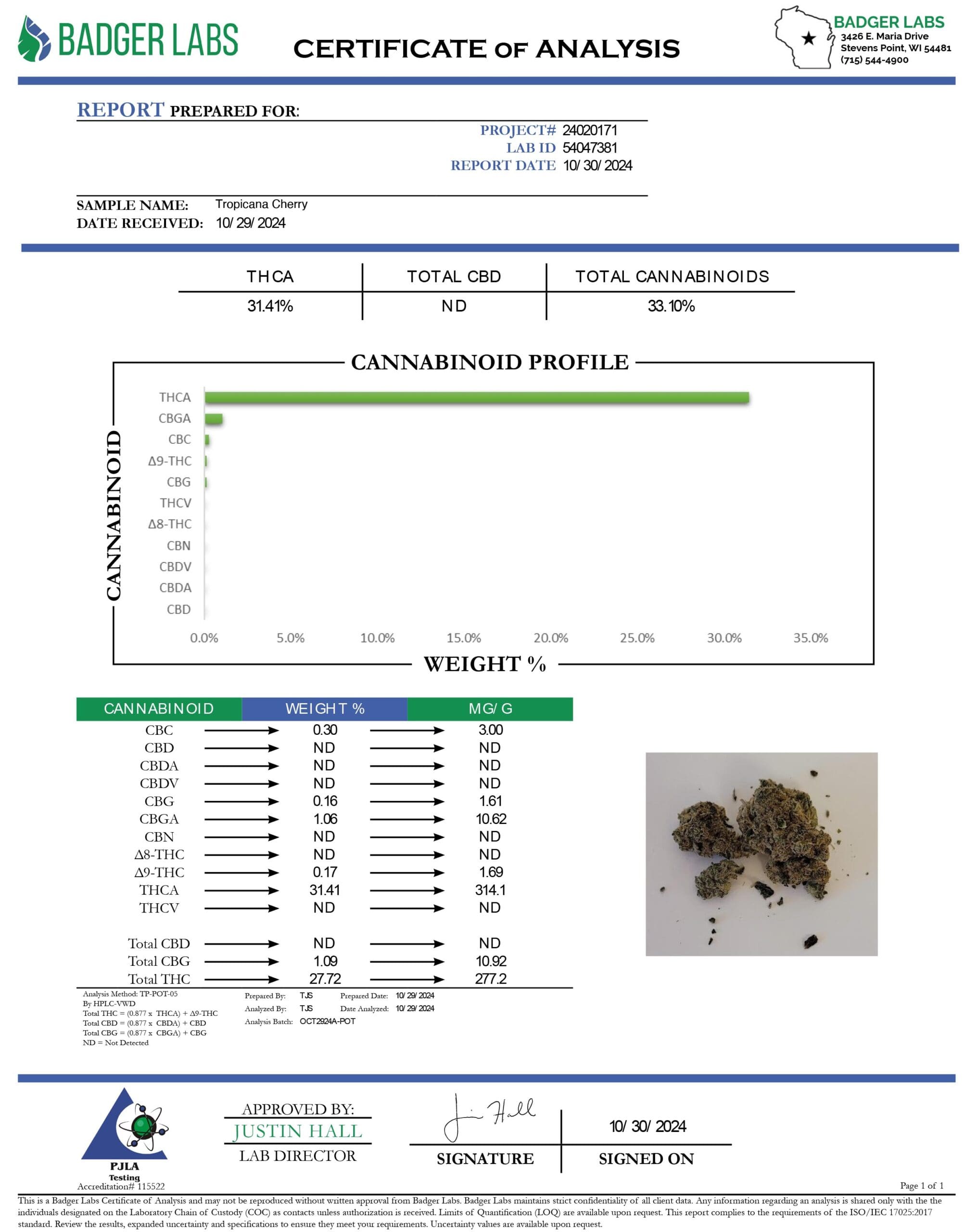
The “no regrets” checklist I use in three stages
The goal is simple: avoid spending on a batch that cannot deliver the flavor and effects you came for. I do this in three stages: jar inspection, sensory check, and vendor accountability.
Stage one: inspect the jar like you mean it
The first thing I check is what the flower looks like in real life, not what it looks like under a bright marketing light. Dense buds tend to hold onto aroma better. Loose, crumbled flower often means a combination of handling and cure issues. That does not automatically mean bad product, but it raises the odds you will get less terpene presence.
Pay attention to color variation. A good batch usually shows some natural range without looking bleached or overly uniform. Green that looks too pale can be a sign of older material or light issues in the grow. Dark, overly cured material can also happen, especially if it was stored badly or exposed to heat and light. You want “alive,” not “tired.”
Then check the trim. When trim is too aggressive, it can strip surface trichomes and make the flower smell less intense even if the strain is correct. When trim is too minimal and leaves too much leaf material, you may get a harsher smoke and more plant flavor. Neither extreme is automatically disqualifying, but it guides what kind of experience you will likely have.
Stage two: smell and texture, the practical indicators
If your product arrives in the jar, smell it before you even think about grinding. Fresh, well cured flower usually carries a clear aroma. You should be able to distinguish cherry or tropical fruit notes rather than only smelling “hay” and faint sweetness. For tropicana cherry strain, the fruit-forward cue is part of the reason people seek it out. If the jar smells muted, the best-case scenario is that it is still decent flower that needs time to open up. The worst-case scenario is that terpenes degraded during storage.
Texture tells you whether it will grind nicely and burn evenly. Flower that is too dry feels brittle and flakes heavily. Flower that feels tacky or springy tends to grind more evenly and usually delivers more consistent aroma during consumption. Be cautious with “wet” flower too. Extremely sticky buds can be a sign of moisture imbalance, which can lead to harshness later. If you ever see a musty odor, treat it as a hard stop.
Stage three: vendor accountability and documentation
This is where a lot of people get lazy. They look at photos and forget the rest. But you are buying a batch, not a vibe. A vendor who can tell you harvest or packaging timing, who can describe cure, and who can stand behind what they sell usually has better control than the one who hides everything behind generic marketing text.
This is also where online shops can show their differences. If you are looking at products sold by Ounce of Hope or similar brands and marketplaces, focus on the transparency: batch details, storage handling, and clear product descriptions. If the listing is vague, ask questions. The best vendors do not mind questions, they just do not love vague buyers.
Here is a compact checklist I use before I commit money.
- Check jar freshness indicators: package date or harvest window if available, and avoid anything that looks like it sat too long.
- Inspect bud density and trim: dense, intact buds generally preserve aroma better than loose, crumbly flower.
- Smell for cherry or tropical clarity: you want fruit notes, not just generic sweetness or hay.
- Assess texture: brittle and dusty often means dry; extremely wet or musty is a warning sign.
- Confirm what you are paying for: compare price per gram and make sure the label matches the batch you receive.
Tropicana cherry strain seeds: the price trap and the quality reality
Buying tropicana cherry strain seeds is a different kind of risk. Instead of cure and storage, the main variables are genetics, seed viability, germination rate, and how reliably the seed provider can reproduce the advertised profile.
With seeds, price can look great until you consider failure rate. That is why the tropicana cherry strain seeds decision needs a quality lens, not just a cost lens. I treat seed buying like buying time and outcomes. Cheap seeds that do not sprout can be more expensive than slightly higher priced seeds that actually germinate cleanly.
Here are the seed quality signs I pay attention to.
First, look for a seller who can explain what they are offering without hand-waving. “Tropicana cherry” can be marketed broadly, but good providers can talk about expected growth patterns, flowering time ranges, and what to expect in aroma development. If you are hunting for tropicana cherry strain review style info, use that as a reality check, but still demand actual seed source clarity.
Second, check logistics. Seeds that are stored in poor conditions lose viability. If the vendor ships slowly in hot weather or refuses to specify handling, you are taking a gamble.
Third, consider how you plan to grow. If you are a newer grower, the most expensive mistake is buying genetics that demand more tuning when you are still learning. A stable and manageable plant often delivers more reliably than a “holy grail” profile you cannot fully support yet.
A quick anecdote from my own shopping mistakes
I once grabbed seeds at a price that looked like a steal because the listing was light on details. The genetics might have been fine, but I did not account for shipping time and the fact that the package sat in a hot area. Half the seeds cracked, the other half did not. I ended up spending extra time reordering, and the final plants took longer to settle. The strain still smelled like fruit when it was ready, but the learning curve delayed everything. That is the kind of cost you do not see when you only compare the seed price.
How to interpret the “tropicana cherry strain info” you find online
A lot of tropicana cherry strain info out there mixes real observations with vague descriptions. Some posts focus on flavor, others on sedation, others on “balanced” without specifics. What helps is identifying what type of user is writing and how they consumed.
Flavor descriptions are usually more dependable than effect descriptions. “Cherry” and “tropical” are easier to verify because smell and taste are consistent sensory channels. Effect claims can still be useful, but only if the reviewer includes consumption method and dose.
When someone writes a tropicana cherry strain review and mentions they used a small dose, waited, and then adjusted, I trust that more than a review that says “it knocked me out” with no context. The strongest mismatch I have seen happens when people buy flower that is older or improperly cured, then assume they got the wrong strain. The strain might be right, but the product condition changes the outcome.
Also, remember that tolerance matters. Someone who consumes daily might interpret the same batch as “light.” Someone who consumes rarely might experience it as “strong.” That’s why the best checklist is not only about the strain name, it’s about batch integrity.
The quality red flags that usually cost you money
These are the things that make a batch less likely to deliver the experience you paid for. If you spot several together, you can assume the odds are against you.
One red flag is a weak smell even when the flower is intact. Another is dryness that forces you to rehydrate or scrape resin out of the jar like you are trying to revive something that should have been ready. Harshness is another. You do not have to taste-test immediately to notice harshness risk. If the trim looks ragged or there is obvious leaf material, expect a less clean smoke.
Storage issues can also show up visually. If the jar looks like it sat in heat, you may see trichome degradation, and the aroma shifts away from fruit toward a more flat, older profile.
Lastly, be suspicious of inconsistencies between the listing and what arrives. If the photos show glossy buds and your product shows crumbly flower, the price might be wrong because you are receiving a different grade or a different batch than advertised.
The quality green flags that signal “worth it”
If you want to maximize your chance of getting the tropicana cherry strain effects people talk about, look for these positives.
A clear fruit smell that still holds when the jar is opened for a minute is a good sign. Buds that are not brittle and do not fall apart immediately are usually a sign the cure is at least decent. A reasonable trim that preserves structure, and does not feel overly stripped, often correlates with stronger terpene expression.
I also like when vendors include practical details. Even simple wording like “packaged on” or “harvested in” shows they care about timing. That timing matters for any strain, and especially for fruit profiles that can fade faster than more earthy scents.
Pricing logic: what is “fair” without pretending we can predict the market
Because I cannot see your local market or the specific batch you are considering, I am not going to give you a single magic price number. What I can do is show you how to decide if tropicana cherry strain price is aligned with quality.
Start by comparing the product to itself. If two sellers list similar packaging sizes, check the price per gram. Then compare expected quality signs. A higher price might be worth it if the aroma is stronger and the buds are intact. A lower price might be worth it if the smell is still present and the texture is decent.
If you feel tempted to buy because the price is lower, but the product checks fail on smell, dryness, or trim, that is your cue to walk away. Cheap can still be a win, but only when the quality indicators are there. Otherwise you are just buying more volume to compensate for weaker experience, and that usually turns into overspending.
Questions to ask before you buy, especially if you cannot smell the product first
Online shopping creates uncertainty. It is fair to demand answers when the product is expensive or hard to evaluate without a jar in your hands. If you are shopping through a vendor that you have not used before, these questions save a lot of regret.
- Do you have a packaging date or harvest date for this batch?
- Where was it stored between harvest, processing, and shipping?
- Can you describe trim intensity and bud size or grade?
- What is the expected aroma profile, and is it based on this batch or general genetics?
- For seeds, what is the germination policy or viability guarantee, and how are seeds stored?
If a vendor answers clearly, you get to buy with more confidence. If they avoid details or talk only in broad terms, treat that as information too.
Putting it all together: your decision in one pass
If you want a simple mental workflow, use this order.
First, confirm you are comparing the same type of product. Flower, pre-rolls, extracts, and seeds do not behave the same, and pricing needs different reasoning. Second, evaluate freshness and handling. That is the biggest predictor of whether fruit profiles deliver. Third, judge the “signals” you can observe: smell clarity, bud integrity, texture, trim, and documentation.
For seeds, switch the lens to viability, source transparency, and storage. You are not buying a jar. You are buying a biological outcome.
If you do this every time, you stop paying for hope and start paying for the actual probability that you will enjoy the batch. That is how you consistently get more from tropicana cherry strain effects, not just from the name on the label.
Final buying mindset for tropicana cherry
The best purchases feel almost boring in hindsight. You did not chase hype. You checked the obvious signs, asked the right questions, and accepted that sometimes the “cheap” option is cheap for a reason. Other times the “premium” option is premium because it is fresher, better cured, or simply more carefully handled.
Whether you are shopping for tropicana cherry strain review style reassurance or you are comparing tropicana cherry strain info across listings, the real leverage comes from doing a batch level inspection. That approach protects your wallet and, more importantly, it protects your time. The fruit notes, the smoothness, and the relaxation you expect all depend on the details that show up before the first puff.
If you are buying from Ounce of Hope or any other retailer, use the same checklist. Quality is not a brand promise, it is a set of signals you can verify. Once you start treating each jar or seed pack like it can be inspected, tropicana cherry stops being a gamble and starts being a repeatable choice.